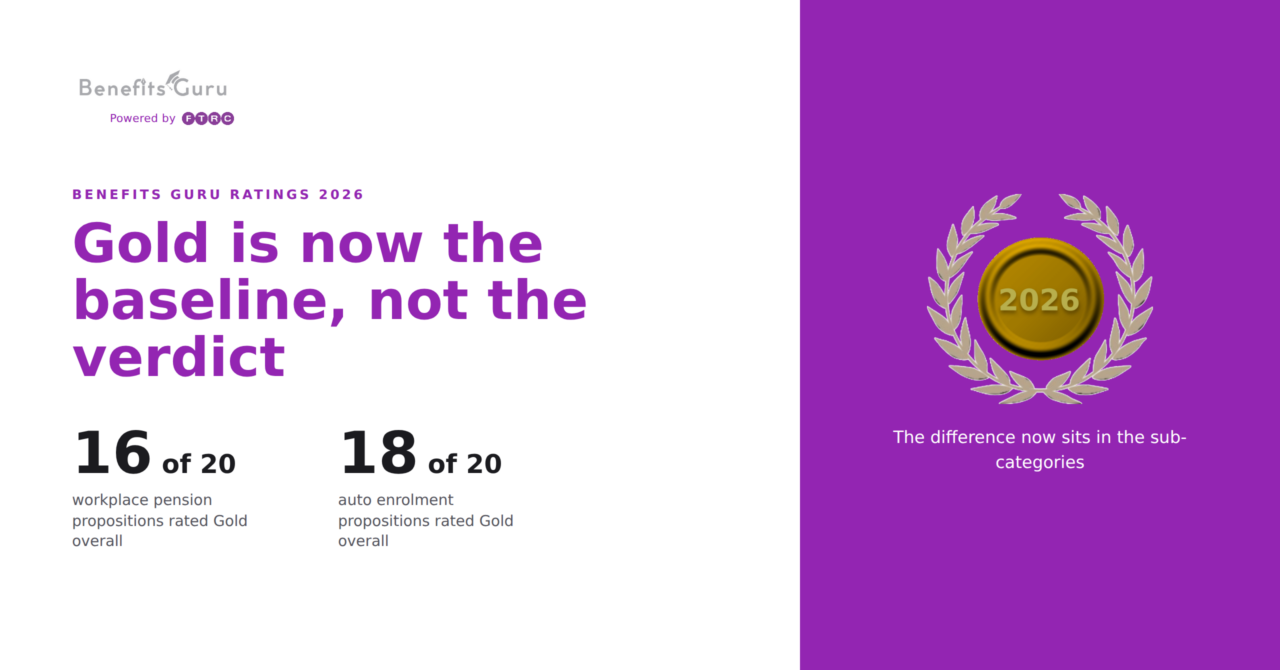
Sixteen of the twenty workplace pension propositions in our 2026 ratings hold an overall gold award. In auto-enrolment it is eighteen of twenty. For an adviser using the ratings to shortlist for an employer client, that is the single most important thing to understand about this year’s results: an overall gold no longer distinguishes much, because most of the market now has one.
This is our twelfth annual Workplace Pensions and Auto Enrolment ratings, covering ten providers and twenty propositions, drawn from more than 12,500 data points held in the Benefits Guru system. Legal and General re-entered this year after a year out, taking an overall gold for workplace pensions and a silver for auto-enrolment. Nest and The People’s Partnership both asked not to be benchmarked.
What the Overall Awards Show
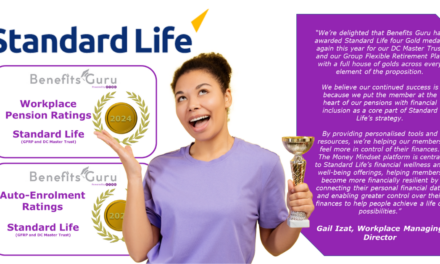
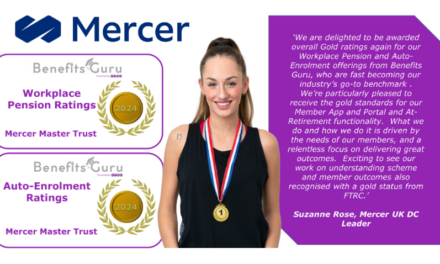
All ten rated providers took at least one overall gold across the two sets of ratings. Seven of them, Aegon, Aviva, Fidelity, Mercer, Royal London, Scottish Widows and Standard Life, took gold in both. Hargreaves Lansdown and True Potential were gold for auto-enrolment and silver for workplace pensions; Legal and General was the reverse.
Only one provider swept the board. Mercer took an overall gold in both ratings and a gold in every single sub-category underneath them, the only provider to do so. Standard Life’s GFRP came within touching distance, gold in every sub-category of both, but its DC Master Trust took a silver for investment and default fund options, so Standard Life as a provider falls just short.
That concentration at the top is the point. When four fifths of a market holds the headline award, the award stops doing the work of telling you which proposition suits a particular employer. The differentiation has moved a layer down.
Where the Propositions Actually Separate
Two workplace sub-categories account for most of the spread. Mobile app functionality is the weakest area in the whole workplace rating, with only eight of twenty propositions reaching gold and twelve sitting at silver. Adviser and member AI is the other, and it is the one we would draw an adviser’s attention to first: five providers achieved gold, two silver, two bronze and one was not applicable. Aegon and Hargreaves Lansdown sit at bronze; Aviva and Fidelity at silver across all their propositions.
Auto-enrolment shows the same pattern in a different place. Proposition design and preparation service is the weakest category there, with eight golds against eleven silvers and a bronze, and auto-enrolment governance is not far behind at twelve golds and eight silvers. Both concern the advisory and oversight work wrapped around a scheme rather than the processing inside it, which is worth noting for an adviser whose own value sits in exactly that territory.
At the other end, some categories have stopped discriminating altogether. Every one of the twenty propositions took gold for data ownership and protection. New scheme setup and onboarding returned nineteen golds and one not applicable. These are now hygiene factors, and a provider scoring well on them is telling you very little that its competitors could not also claim.
The New Categories Landed Better Than Expected
We introduced three new benchmarks this year: member communications and behavioural nudges, member insights and analysis, and support for members at retirement. New criteria usually expose a market that has not caught up yet. These did not. Member communications and behavioural nudges returned eighteen golds out of twenty, member insights and analysis eighteen, and retirement member support seventeen.
The more interesting reading is the contrast with mobile app functionality. Providers have invested heavily in what they send members and what they can tell an employer about them, while the app the member actually opens has moved more slowly. If a scheme sponsor’s engagement strategy rests on the app rather than on the communications programme behind it, that gap is worth probing at the next review.
Three Reforms, Three Different Stages
Much of what providers have built over the past year has been driven by three regulatory changes, and they are at genuinely different stages. Conflating them is easy and unhelpful.
The FCA’s targeted support regime is already live. Final rules were confirmed in PS25/22 and the regime took effect on 6 April 2026, so this is now an operating reality rather than a preparation exercise, and the question for a scheme sponsor is what their provider is actually delivering under it.
Pensions dashboards connection is imminent. Under the Pensions Dashboards Regulations 2022, all schemes and providers in scope must be connected by 31 October 2026, which is a matter of weeks away. Connection is a legal obligation on the scheme rather than a service feature, so this belongs on the agenda of every trustee board and sponsor you advise that has not already confirmed its position.
The value for money framework is the one still in flight. The FCA consulted most recently through CP26/25, published on 13 July 2026 and closed on 15 September 2026, developed jointly with the DWP and The Pensions Regulator. Rules are expected during 2027, with the first assessments falling on larger schemes and master trusts from 2028 and the remaining in-scope schemes from 2029. It is not yet a compliance obligation, and anyone describing it as one is ahead of the regulation.
What It Means for Advisers
The practical consequence of a market this bunched at the top is that provider selection has to be argued on specifics. An overall gold is now close to an entry requirement, so a recommendation that rests on it is not really a recommendation at all. The sub-category detail, particularly in the areas where the spread is widest, is where a defensible comparison lives.
It also means the questions worth asking a provider have changed. Not whether they are ready for dashboards, because the deadline leaves no room for anything else, but what they are doing under targeted support now that it is live, how their member-facing technology compares with their communications capability, and what their value for money preparation looks like given the first assessments are still two years out. The full ratings tables and individual provider factsheets are available on the Benefits Guru site.